
How we help you
Your manufacturing business faces cybersecurity threats, regulatory compliance requirements and the risk of financial, operational and reputational damage should a cyberattack succeed. We help you build stronger defenses.
Understand your cybersecurity risks
Strengthen your existing cyber defenses
Meet regulatory compliance requirements
Get both strategic and ground-level security insight
Cybersecurity that meets the needs of manufacturers
Our cybersecurity advisors understand your business and the specific threats you face. We don’t just see security as an IT problem, but a risk management challenge that affects every aspect of your business — and work diligently to protect your data and your cash flow.
Explore our cybersecurity services
Assess your organization’s risk related to critical cybersecurity threats, including external breaches, unauthorized system access, ransomware attacks, operational disruptions and the loss or theft of sensitive data and financial assets.
Validate the strength of your cybersecurity defenses by simulating real-world attack scenarios using tactics such as penetration testing and social engineering.
Wipfli helps you ensure security, continuity and availability of critical data, operational documents and technologies so that you can return to production faster after an incident.
Leverage a comprehensive managed security services that combine 24/7 monitoring, managed detection and response, and security event management into a package that delivers high-speed, high-touch protection that fits your budget.
Wipfli can help you evaluate how your current practices align with cybersecurity standards, including the NIST Cybersecurity Framework, regulatory compliance mandates, and manufacturing cybersecurity best practices.
Give our team access to your systems and cloud, and we’ll help you pinpoint vulnerabilities that could expose your operations to cyberthreats.
Build trust and meet evolving regulatory demands with a virtual chief information security officer (vCISO) service. We deliver strategic cybersecurity leadership to strengthen your security program and keep it aligned with business goals and industry standards.
Wipfli’s cybersecurity solutions for manufacturing can be tailored to the unique regulatory and operational demands of your business and the clients you serve, including healthcare. We specialize in key compliance frameworks, including FFIEC, NAIC, CMMC, HIPAA and PCI.
Insights and resources
ARTICLE
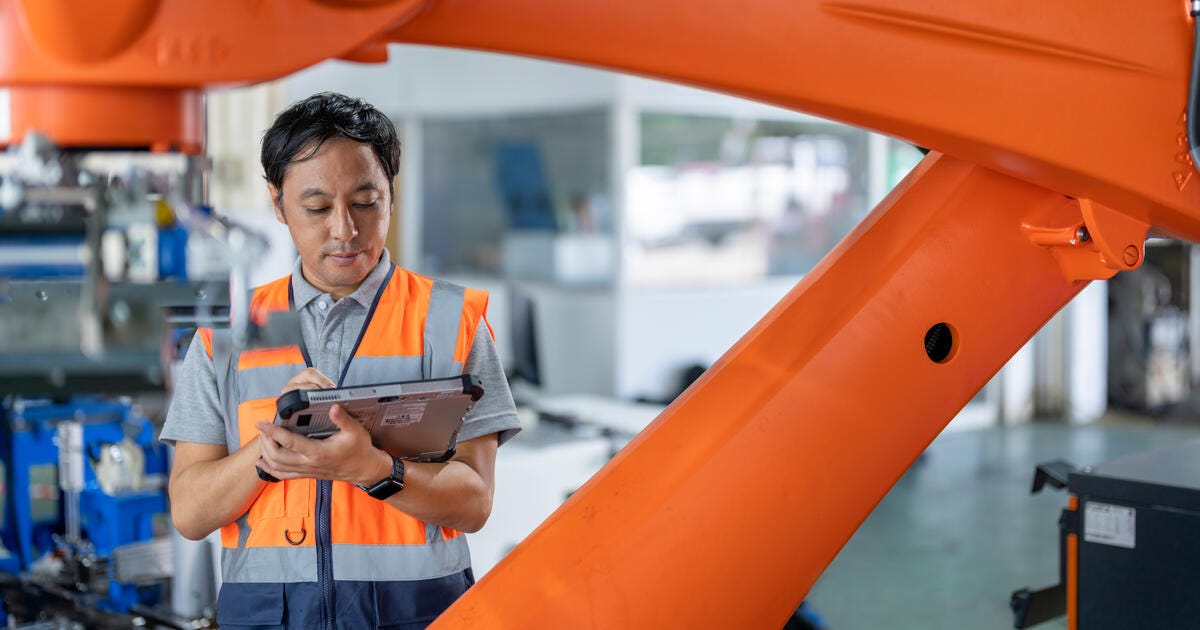
Pros and cons of robotics in manufacturing
Today’s industrial robots operate across a wide range of industries, from semiconductors and automobiles to plastics processing and metal forging. Pretty much any repetitive operation is a great job for a robot, particularly if it’s dangerous or difficult for people. Manufacturing robots have been used for high-volume processes, but as the technology advances and the cost of industrial robots declines, more options and opportunities are opening for medium- and small-sized operations to leverage robot manufacturing. These robots also help manufacturers address tight labor pools, global market competitiveness and safety. If you’re curious whether robots can enhance your value stream, here are the main pros and cons to consider when it comes to industrial automation and robotics: What are industrial robots? Industrial robots are programmable machines designed to perform manufacturing tasks with precision, speed and repeatability, typically without direct human intervention. Industrial robots are highly flexible and can be reprogrammed to handle a range of tasks across different production lines. They integrate with broader manufacturing systems, including industrial internet of things (IIoT) platforms, vision systems and ERP software, to support data-driven operations. For manufacturers, they represent a practical path to improving throughput, quality and workforce safety across the value stream. According to the International Federation of Robotics, the global stock of operational industrial robots reached a record 3.9 million units in 2022 . That figure continues to grow as manufacturers of all sizes look to automation to sustain throughput and reduce dependence on constrained labor markets. Advantages of industrial robots Here are some of the advantages manufacturers often experience when they add industrial robots to their production floor: 1. Better quality control and consistency Along with other tech — such as the IIoT, artificial intelligence, data analytics or 3D printing robots — industrial robots are able to provide better production quality and more precise and reliable processes. Added benefits also include reduced cycle times and real-time monitoring to improve preventive maintenance practices. 2. Maximum productivity and throughput An industrial robot increases speed for manufacturing processes, in part by operating 24/7. Robots don’t need breaks or shift changes. The speed and dependability of robots ultimately reduce cycle time and maximize throughput. Robotic factory automation and manufacturing with robotics enables high efficiency. 3. Greater safety Using robots for repetitive tasks reduces the risk of injury for workers, especially when manufacturing must take place under hostile conditions. In addition, supervisors can oversee the process online or via remote monitoring. 4. Reduced direct labor costs The cost of having a person handle many manufacturing operations is often more expensive than a robot. This can also free up workers so their skills and knowledge can be used in other business areas, such as engineering, programming and maintenance of the robotics used in manufacturing. 5. Keeping manufacturing in the U.S. Some argue that robots are taking jobs away from U.S. workers, but that’s not necessarily the case. Industrial robots are typically integrated into a series of operations that require human expertise. For example, you could have a robot welding parts that are handed off to a person to perform a task that requires a human’s intuitive “if, then” thinking. The future of robotics in manufacturing involves humans and robots working together in factories. Disadvantages of industrial robots Industrial robots are not without tradeoffs. Before moving forward with automation, it’s important to plan accordingly for these potential challenges: 1. High initial investment Robots typically require a large upfront investment. As you research your business case for purchasing, consider all the costs of industrial robots, including installation and configuration. You should also evaluate whether your robot can be easily modified if you need to alter its operation in the future. Robotics for manufacturing is a significant investment. 2. Expertise can be scarce Industrial robots need sophisticated operation, maintenance and programming from controls engineers. While the number of people with these skills is growing, it’s currently limited. As a result, it’s important to consider the personnel investment you’ll need to make to bring in that expertise or “retool” your existing staff to take on the task of working with robots in industrial automation. 3. Ongoing costs While industrial robots may reduce some manufacturing labor costs, they do come with their own ongoing expenses, such as maintenance. In addition, you’ll want to consider the costs to keep your robot and any related IIoT-connected devices protected from cyberthreats. Industrial robots vs collaborative robots Industrial robots and collaborative robots (aka cobots) serve different purposes on the manufacturing floor, and understanding the distinction is critical before making an investment decision. Traditional industrial robots are built for speed, precision and high payload. They typically operate behind safety barriers or in fully fenced cells, isolated from human workers during operation. This makes them well-suited for high-volume, high-speed applications such as welding, stamping, or painting, and for environments where throughput is the priority and task variation is low. The tradeoff is complexity. Programming, integration and safety infrastructure require significant upfront planning and controls engineering support. On the other hand, collaborative robots are designed to work alongside people in shared spaces without physical barriers. They use sensors and force-limiting technology to detect and respond to human presence, making them a practical option for operations that require frequent task changes, limited floor space or tighter labor integration. Cobots generally carry lower payloads and operate at slower speeds than traditional industrial robots, but they can be deployed and reprogrammed more quickly, which is advantageous for mid-size manufacturers managing product variety or shorter production runs. Manufacturers need to match the right technology to the right application. A single facility might use traditional robots for high-speed assembly and cobots for inspection, packaging or tasks that benefit from human-robot collaboration. Evaluating your production environment, workforce structure and growth trajectory is the starting point for making that determination. Feature Industrial robots Collaborative robots (cobots) Operating environment Isolated, behind safety barriers Shared space with human workers Speed High Moderate Payload capacity High (up to several hundred kg) Lower (typically under 35 kg) Programming complexity Higher — requires controls engineering Lower — often teach-pendant or app-based Upfront cost Higher Lower Deployment time Longer Faster Best for High-volume, repetitive, high-speed tasks Flexible, variable or human-adjacent tasks Safety infrastructure Required (caging, fencing) Built-in sensors; no caging required Reprogramming flexibility Moderate High Ideal operation size Large-scale production lines Small to mid-size operations or flexible lines Read more Best practices for inventory optimization in manufacturing and distribution Improving profitability and margins in manufacturing 9 tariff mitigation strategies for U.S. manufacturers

ARTICLE
Cybersecurity in manufacturing: Strategies to mitigate risk
Cybersecurity in manufacturing: Learn about the threats facing the industry and the defense actions your business should take.

ARTICLE
SAP ECC end of support: what manufacturers must do next | Wipfli
SAP ECC end of support is approaching. Learn how manufacturers can assess ERP readiness, improve processes, prepare data and choose a replacement platform.
Reach out to our team
Let's talk about how we can help you mitigate your risks, meet compliance requirements and protect your business. Our manufacturing cybersecurity team knows the challenges you face and how to take action to solve them.

LET'S CONNECT
Discover how Wipfli can help you overcome barriers to profitability and build smarter, leaner operations.